One of the most prolific gothic country artists of the past decade, King Dude doesn’t particularly attempt to change up the formula on Full Virgo Moon— namely a lot of reverb, late ‘80s neofolk, and Tumblr Catholic moodboards— but it still lends itself to his strongest body of work yet.
There’s a co-habitual gentleness and depth on standout track “My Rose By The Sea”: Thomas Jefferson Cowgill’s haggard yet delicate delivery of “I’m just a satyr boy for you, my love / a toy, for you, my love” is backed by rising and receding yawns of synths in a particularly beautiful way. The ethereal opening chords to “Full Virgo Moon” are tinted with sweeping shadows and ultraviolet colors, conjuring up its titular image in vivid detail. Not everything is all atmospheric and Anna Von Hausswolff, though— “Forty Fives Say Six Six Six” is an unusually rolicking track that leans into the country in gothic country, and closer “Something About Me” is so misty and light that it nearly veers entirely into dream pop. Cowgill’s characteristic sense of off-key humor (one recalls the track “I Want To Die at 69” off of 2016’s Sex) is sharper— or blunter— than ever, with half of “Make Me Blind” being comprised of the straightfaced refrain of “Oh, Death, you filthy whore / I crave you more and more.” By the time he reprises the line in a whisper, literally trembling with emotion, on next track “A Funeral Song for Atheists,” it’s hard not to laugh out loud at the absurdity of it all. Even then, the hesitation in the rising solo piano line is devastatingly genuine, and you’re drawn back into the rest of the song as the thought reaches its sweet and final note and calmly completes itself. Here is someone who can lean fully into both words in gothic country, delivering on the promises of his bygone influences, while still— almost maddeningly— not taking himself too seriously. —Eight.
Sounding like a cross between Black Marble and Future Islands, quartet Cold Beat adroitly navigate between coldwave and indie pop on Mother. The band’s one and only surprise hit, 2017’s “62 Moons,” seems to accurately sum up the band’s appeal: it encapsulated classic post-punk sensibility and snares within a dreamy pop structure to stand out from other laid-back Spotify-core cuts. The same goes for the fairly excellent Mother, though the project does find the band heading in a colder direction, sounding more and more like A Different Arrangement than Singles. Lead vocalist Hannah Lew provides atmospheric if somewhat forgettable vocals, singing as gently as would a choir girl with her eyes closed.
“Pearls” is the (pun unintended) crown jewel of the record, feeling like a coy, softer throwback to early ‘00s dance-punk— and it is a DFA Records release, after all. Synths swarm in jeweled, IDM-like formation as Lew delivers her best performance, her wistful simplicity working perfectly in tandem with the complex instrumentation underneath. (Other cuts include the ballroom-like “Double Sided Mirror” and whimsical mysticism of “Paper.”) Enjoyable if not wholly engaging, Mother is still a lovely little standout from the recent surge of synth-based post-punk. — Seven and a half.
King Krule’s Man Alive! finds the hit art rocker returning to experiment with everything from neo-psychedelia and no wave to classically tense post-punk. The tracklist flows so easily that you could be fooled into thinking Archy Marshall’s process was effortless, first drawing you in with the coldly laid-back “Cellular” before the rest of the A-side stuns you with hit after hit. “Stoned Again” is especially unexpected highlight, catching you off-guard with Marshall’s unforgettable concession of “Yeah, she’s my sweet, my sweet and sour, my lemon honey,” though his infamously low register and smirking cadence twist the words into a threat rather than an already puzzling compliment. His laugh on the subsequent line— “Ran all the way home that night/ran back my mummy”— drives the song into even deeper aberration, and that’s even before the terrifically dark jazz section rears its head.
Similar banger “Comet Face” follows the trend of almost labyrinthe post-punk (thought you wouldn’t see that adjective outside of a Preoccupations review, huh?), opening with a maddening buzz before launching into a unrelenting, driving pulse as Marshall mumbles apocalyptically overhead. The B-side does tend to drag in its freeform structure— at times falling into my earlier fears of Marshall becoming too laid back after hearing early single “(Don’t Let the Dragon) Draag On”— but still rounds out the record in an overall cohesive effort. This record’s overall brilliantly crafted atmosphere is woven on a knife’s edge. It offers tension, hostility, the smiling snarl of a guard dog who knows, by feel alone, the range of the slack chain around his neck. Man Alive! is the uncertain weight of an overcast evening half-refined into music; ultimately shining, but flaws and edges still intact.
The release of both Man Alive! and Tame Impala’s emptily mediocre The Slow Rush nearly back-to-back was an amusing coincidence, seeing as both were relatively independent acts with a surprising measure of success from what some could call “outsider” fans. The general public might have accepted your strangeness, but that doesn’t mean you need to start writing with their unconscious presence weighing down on your pen. If anything, this record is proof you should get even weirder. —Eight.
Stray is forty minutes of a Southern gothic purgatory, sending you hurtling through a pitch-black, rain-soaked tumult of soulless yet deeply compelling characters. The record succeeds on both fronts here: it’s absolutely stunning, both lyrically and musically. The former succeeds to the point where I’m actually angry about it: the line “Burning through Georgia like a moonstruck Sherman” still reverberates in my head, weeks later. Speaking of which, the song that’s on— lead single “Serafina”— is gorgeously chilling, telling the darkly beautiful story of two outcast women who fall in love with fire and then each other. (Another line I’ll be thinking about for the rest of the year: “Sadie said, “I’m gonna buy us an old house in a big town/Where we can start a life and burn it all to the ground.”) Follow-up single “Heat Lightning” will probably be my favorite song of the year (or at least until Protomartyr finally drops something.) It’s a musical storm, somehow rendering the titular heat lightning with nothing but instruments and pedals. There’s genuine hatred in Reid Bateh’s voice on the chorus when, in a sudden scream, he insists that “they can’t explain every little thing.” You almost feel bad for the weathermen he’s referring to— “What the hell did they do this guy?” you wonder. In fact, every song on here has some moment that will draw you up short, whether it’s the storytelling in “Ben & Lily” (“’I’m a eunuch,’ Ben said/’I was in my prime when they cut me down/Yeah, they were tired of me chasing their daughters/And burning their precious mill to the ground’”) or the misty atmosphere of near-ballad “Sing Me to the Street.”
I’d somehow managed to miss all the singles running up to Stray, so I had absolutely no idea what I was getting myself into. I’d thought nothing of Bambara before, finding their relatively well-received 2018 Shadow on Everything emotionless and washed-out. Two minutes into opener “Miracle,” I was literally stunned. I almost want to say Bambara pulled a DIIV, though the former’s jump in quality in the span of under two years is almost laughably more significant. And since we’re on the topic of post-punk comparisons, I’m sure a surfeit of Iceage and Nick Cave comparisons have already been tossed back and forth, but I’ll argue that this record does what both fall just short of: there’s a nihilism here so potent and ingrained . Elias Ronnenfelt gets the reputation forbeing the transgressive bad boy of contemporary post-punk (he regularly cites The Torture Garden, The Story of O, and Bret Easton Ellis in interviews), but the most he can muster lyrically are some questionable lines about STDs on 2018’s Beyondless. No, there’s something about the snarl in Reid Bateh’s voice when he paints apocalyptic imagery like “They dream of young versions of their wives” or “She kicked me in the teeth for my crying/Hooked me on a leash and then she tied it/Tightly to a tree where her little dogs piss” that’s wholly, totally immersed in misanthropy. He’s sneering at the state of the world, but it’s laced with a very bleak defeat, too: on closer “Machete,” the first-person narrator, under the illusion of escape, realizes that he’s still being pursued by Death: “Now it seems/Like a violence is a mist/Slowly creeping from the past/And I can’t help but feel he’s coming back for me.” There’s no resolution to Death’s odyssey— he’s introduced while driving aimlessly across the West and pissing on lightning bugs, before he makes his final ambiguous non-appearance as a trail of dead following the narrator. Like I said earlier, this really is 43 minutes of purgatory: an ultimately meaningless one-take shot of Death meandering across America, corruption and hedonism and unfairly good gothic noise rock following in his wake.
I said this about the lyrics already, but it applies to the whole effort, too: Stray is the kind of record that makes me angry about how great it is. Whatever you do, do not miss out on the next generation of punk blues prophets. —Nine and a half.
I’d somehow managed to miss all the singles running up to Stray, so I had absolutely no idea what I was getting myself into. I’d thought nothing of Bambara before, finding their relatively well-received 2018 Shadow on Everything washed-out and forgettable. In contrast, two minutes into opener “Miracle,” I was literally frozen in my seat. I almost want to say Bambara pulled a DIIV, though the former’s jump in quality in the span of under two years is almost laughably more significant. And since we’re on the topic of post-punk comparisons, I’m sure a surfeit of Iceage and Nick Cave comparisons have already been tossed back and forth, but I’ll argue that this record does what both fall just short of: there’s a nihilism here so potent and deeply ingrained that you almost recoil in shock. Elias Ronnenfelt gets the reputation for being the transgressive bad boy of contemporary post-punk (he regularly cites The Torture Garden, The Story of O, and Bret Easton Ellis in interviews), but the most he can muster lyrically are some questionable lines about STDs on 2018’s Beyondless. No, there’s something about the snarl in Reid Bateh’s voice when he paints apocalyptic imagery like “They dream of young versions of their wives” or “She kicked me in the teeth for my crying/Hooked me on a leash and then she tied it/Tightly to a tree where her little dogs piss” that’s wholly, totally immersed in misanthropy. He’s sneering at the state of the world, but it’s laced with a very bleak defeat, too: on closer “Machete,” the first-person narrator, under the illusion of escape, realizes that he’s still being pursued by Death: “Now it seems/Like a violence is a mist/Slowly creeping from the past/And I can’t help but feel he’s coming back for me.” There’s no resolution to Death’s odyssey— he’s introduced while driving aimlessly across the West and pissing on lightning bugs, before he makes his final ambiguous non-appearance as a trail of dead following the narrator. Like I said earlier, this really is 43 minutes of purgatory: an ultimately meaningless one-take shot of Death meandering across America, corruption and hedonism and unfairly good gothic noise rock following in his wake.
I said this about the lyrics already, but it applies to the whole effort, too: Stray is the kind of record that makes me angry about how great it is. Whatever you do, do not miss out on the next generation of punk blues prophets.
(Author’s note: Earlier, on my review of Public Strain, I’d claimed that I couldn’t find the words to describe Women’s “Eyesore?” I changed my mind, but it needed a separate review.)
It snowed all of this past Saturday. That’s pretty rare in Georgia— Northerners joke that we cancel everything as soon as we see a single flake, but that’s not wholly inaccurate. My manager texted me to call off my shift, and I spent the morning adjusting my schedule and trying to figure out how to make hot chocolate before I finally took a second to just look out the window. I hadn’t seen snow in a long while. Everything was very clean. Light gleamed dimly off of denuded trees. The flowers were buried under soft, white layers. I don’t even remember putting on “Eyesore”— I almost want to believe it just happened. But all I remember thinking is: Thank God, I finally get to listen to this in the snow.
Sometimes, you come across a song that you bury into. You tunnel it out; you make a home inside of it. As of February 11, 2020, I’ve listened to “Eyesore” 496 times, yet every listen still feels like I’m hearing an entirely new song. See, the first thing that pulls you in is the intro. I didn’t like the rest of the song at first. I listened to this maybe fifty times just for that intro. “Eyesore” is really best experienced at the end of Public Strain: after ten songs of an ambient morass, four abrupt and clear-cut measures of isolated snare shock you, before the late Christopher Reimer near-violently cuts in with the precision of a Japanese kitchen knife. His playing is impossibly delicate and jagged at the same time, jewel-toned and fathomless and textured like granulated sugar. I have never heard any guitarist do what he did, and I don’t think I ever will.
The lyricism is on Public Strain is very good, but not good as in Protomartyr where the sharp music exists before the even sharper lyrics form upon it, or good as in Preoccupations where the words twist and turn and supplement the grandiosity of the rest of the band. Women’s lyrics are the music. Words like “spill and heat” consume the guitars as well as the lights, until Flegel’s voice has melted and become another instrument. And nothing at all surpasses the final lyrics Women will ever sing to you. It’s one of the most haunting quatrains of the decade:
Overboard, ahead of me You’re not lying next to me Just below your swaying palms Hidden by a bank machine
There’s a very profound, unspoken sadness there. And that line especially: “you’re not lying next to me.” I can lose myself in the loss and resignation conveyed in just six words, and the careful emphasis Flegel places on the “next;” lilting upwards, sweetly eerie. Eventually, he trails off and lets the riff speak for itself. That too then drops off in volume, and you think the last four measures will repeat themselves until the outro fades out entirely, like many pop songs that have come before it.
But at the last second, it comes to a conclusion, however gently.
My dad drives me to school every morning around six AM. I’ve usually stayed up until two or so the past night, and I’m very tired, can’t stand listening to anything that isn’t easy on the ears (which, in my case, typically translates to lo-fi). This morning, barely conscious and buried under a soft blanket, I stared out at the muted orange glow of parking lot lights through a fogged-up window. I thought about the dull light against snow that I won’t see again, not for a long time. I thought about the flowers we’d worked so hard to care for over the past few months, and how we’d woken up to find them abruptly buried under all of that gleam and ice. And I thought about two dark figures in some dun-colored Canadian snowstorm, their destination unknown, but their moment of movement captured at that very instant; forever static, and forever a conclusion.
I’ll just be blunt: I’ve absolutely hated HMLTD’s previous work. Somewhere in between all of the glam and the punk, they’d forgotten about the actual music itself, and 2018’s generally panned EP Hate Music Last Time Delete was some of the most atrociously handled rock music I’d had the unfortunate opportunity to subject myself to. I didn’t even want to write about it; I just wanted to forget it had happened.
The rollout for West of Eden wasn’t so encouraging either: NME and Quietus articles mostly featured various HMLTDs whining about being cancelled over queerbaiting (a cursory search for “HMLTD” and “cancelled” on Twitter reveals nothing) and being a once-hyped band, dead in the water by anyone’s fault but their own. I found it insufferable. So I went into this record expecting to write something cursory and dismissive, making fun of this specifically London-brand of failed post-punk revival. About two songs in, I realized two things at the same time: (1) this was a good album and (2) damn, I would actually have to write a thorough piece about it.
The title track and opener immediately arrests you with some uncharacteristically great lyrics, featuring frontman Henry Chisholm starkly soothsaying the visage of “two drowned dogs float[ing] belly side up […] two girls spin around a mobius strip club.” Their message of the titular West being dead, though interesting, doesn’t develop into much besides a bombastic mission statement, though it does manage to carry the A-side through to to completion. The next truly interesting cut off of the record is 2016’s bizarre single “To The Door.” Though insane enough to pull off the cowboy trap phenomenon before Lil Nas X had even deleted his Nicki Minaj stan account, it feels completely at home in between cowpunk ditty “The Ballad of Calamity Jones” and punk blues epic “Satan, Luella, & I.” The record feels, strangely enough, as evocative of Country Teasers as Travis Scott. I don’t consider myself much of a hip hop head, but trap moments on this track are genuinely excellent, though I see how it would be alienating to older listeners. With all the eclectic mishmash of frankly insane genres all across this generally guitar-based record, this could certainly be described as post-punk for generation Z, though I don’t know why you’d want to do that. Instead, I invite the reader to explore the successes and failures of their art punk contemporaries.This, perhaps, is why fellow London provocateurs like Warmduscher and Fat White Family stand out among dreary punk peers like Mush and Gonzo. Instead of treading the same tired lines of plucky, angular guitar music, they’re incorporating every type of genre they encounter (one recalls house, alternative dance, acid rock, dream pop…). It becomes a genuinely interesting, modernized effort, even if they
And don’t get me wrong: the record does not pull it off the whole way through. The lyrics are still devastatingly juvenile— “Satan, Luella, & I” has all the subtlety of a high school sophomore who just figured out what centrism is, or Matty Healy, or both— and the narrative pair of “Joanna” and “Where’s Joanna?” verges on Bret Easton Ellis levels of oblivious un-irony. Yes, this is an incredibly pompous band, composed of upper middle class kids taking themselves way too seriously. But for all that, West of Eden is still a hell of a lot of genre-bending fun. —Eight.
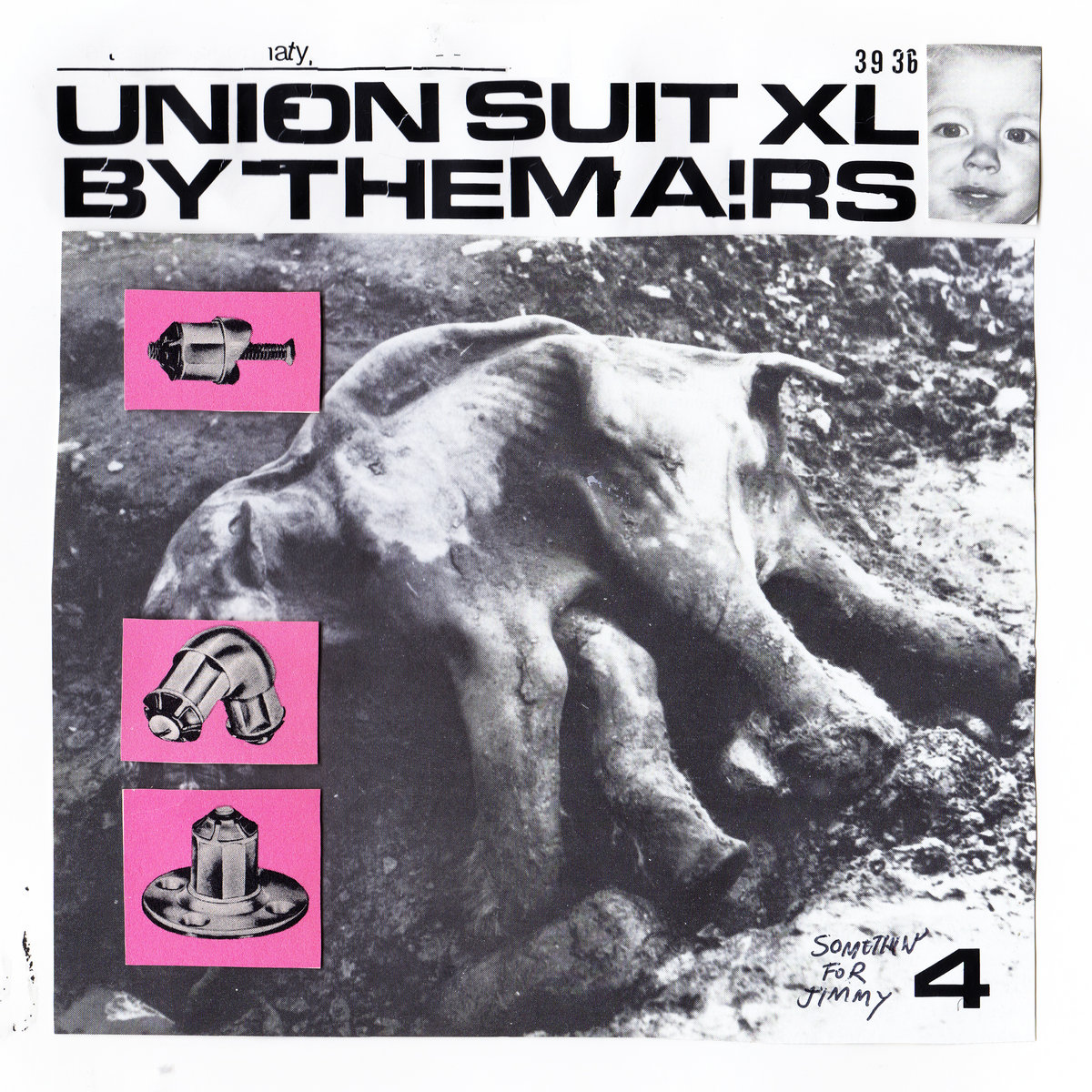
I first learned of Them Airs after last year’s Echo Park Bomb City, a pretty good if mostly forgettable DIY Bandcamp-punk record. 2020’s Union Suit XL, on the other hand, takes their rough brand of American art punk and— if not refines— elevates it to a pleasantly developed fourth studio album.
There’s something almost Spiderland-like about Them Airs’ youth and packaging— they’re teasingly authentic, displaying a typical Mark E. Smithian irreverence for the guitar music scene they find themselves in, while still delivering earnestly original performances. “I was at the Car Seat Headrest at Collins Street,” lead vocalist Cade Williams muses on “Innovation Leads to Distinction” in a rarely sober moment— his follow-up delivery of “there was a tension that night that I could not explain” eerily channels a somewhat less bleak “Don Aman” as the track bleeds into the cluttered, lo-fi “Bole”, a transition that wouldn’t seem out of place on Women’s equally as genre-blind 2010 self-titled. There’s a calculated playfulness of excellent tracks like “Burning Participant” and “Slag Heap”— not calculated in the sense that there’s anything inauthentic about their delivery, but rather in the sense that you can tell these are technically talented players having as much fun as they can wring out of the job. British art punk influence permeates the tracklist, particularly moments like their insidious chant of “reception, reception, reception, reception” on opener Reception Desk or the infamous trope of the dual vocalist call-and-response on “Wade/Cull”. But, refreshingly, Them Airs accomplishes what acts like Bodega and Pill think they’re doing— where these other American punk groups wallow too meticulously in their own pretensions, Them Airs brushes past these concerns quickly and never spends too long on one idea, running through tracks as short as 51 seconds long without stopping for breath.
Admittedly, Union Suit XL is not perfect, not even by those aforementioned Bandcamp-punk standards. One feels as if Them Airs could generate the same hype as similarly young post-punk acts like black midi or Black Country New Road if they’d only put more form and methodology into their madness— they’ve certainly gotten the attitude down, with an official and helpfully detailed Neocities page (members list their favorite record as “HOUSE” and “DAKHABRAKHA”) and excellent song titles like “Corpse at UMass Dartmouth”. If you’ll forgive my music journalism vocabulary for a second, Them Airs really is a Promising Young Band. They’re already jaded by the money-making industry they live in the shadow of, yet remain pleasantly derisive without veering into overt scorn. They wear their post-punk influences on their sleeves, yet never fall into the genre’s trap of trying to emulate just one group. If anything sums up these two refreshing points in five words, it’s the conclusion of the following anecdote: recently, I posted an Instagram story where I briefly enthused over the album and jokingly captioned “long live Devocore”. Not Devocore, the band surprisingly replied. Direct quote: “The proper term is Devo-tional.” —Eight.
Though I’m loath to compare Algiers to TV on the Radio after August’s scathingly hilarious “Can the Sub_Bass Speak?”, the comparison bares its neck so temptingly that I just couldn’t resist. Let’s throw in all the bygone heroes of early 00′s post-punk revival while we’re at it, actually, Interpol and The Rapture and The Walkmen be damned. What do all four of these fallen names infamously have in common? They began interestingly enough, were heralded as innovative geniuses, attracted plenty of trendy NME and Spin attention, and then phoned it in not a few years later. You can go through each group’s discography and see the exact moment where records stopped being put out as creativity and started being put out as career padding.
What’s really dismaying is that Algiers hit that block on their third record. I’m sitting here on January 17th, 2020, wincingly watching it happen in real time.
There Is No Year begins strongly enough, with their classic brand of high-energy originality that I’d previously admired on 2015′s The Underside of Power. The title track all but cold opens with vocalist Franklin James Fisher’s isolated and bombastic delivery of “Now it’s two minutes to midnight / and they’re building houses of cards”, drawing you into the rest of the next three minutes of autobahn-quick synths and inspired lyricism. The next two tracks continue in more or less the same vein, though it’s a pretty enjoyable vein— “Hour of the Furnaces” features a darkly spirited chorus and one of their career’s best, and “Dispossession’s” siren-like background instrumentals induce a distinctly apocalyptic atmosphere that perfectly complement the song’s tone. You get the sense that Algiers is about to say something really important, because Algiers has positioned themselves up in your face, insisting that they’re about to say something really important.
Then, bafflingly enough, “Losing is Ours” shows up, and demarcates the boundary where the record abruptly trips over itself and— there’s no other word for it— flatlines. Nothing especially distinguishes songs from one another beyond the similarly plodding tempos. Sure, “Chaka” has some interesting jazzy moments (dare I say no wave? I want everything to be no wave, damn it), Fisher’s delivery on “Nothing Bloomed” is so delicately beautiful that it’ll draw you up short, and “Void” is a redemption of a closer with an especially excellent performance on part of former Bloc Party drummer Matt Tong. But it would take me another month before I could tell any of the rest of these apart, and I honestly have no desire to dedicate the time to doing that.
These are not bad songs and this is not a bad album. I was never actively repulsed by anything past “Hour of the Furnaces”, and there were plenty of pleasant moments beyond the ones I mentioned above. Phoning it in doesn’t necessarily mean your music becomes completely unenjoyable— hell, I loved last year’s Foxygen record, and they didn’t even bother to tour that one. The problem is that they’re not doing anything new, and that’s disappointing to hear from a band that was so recently creative as Algiers. Today, the lyrics to “Can the Sub_Bass Speak?” feel less like devastating tongue-lashings and more like nervous, 8 Mile-esque excuses for where the band knew they were about to go. —Six and a half.
Right from the first glowing notes of opener “Can’t You See”’s nocturnal bassline, Public Strain already feels jarringly displaced from time. Immediately, you get the sense that this is a delicate, intentional effect. After all, was there ever an album that spilled and melted and deformed itself more naturally than Women’s second– and infamously final– record? From the cryptic, diaphanous lyrics– “Spill and heat consume both the lights”, “Enter the mirror, the grays disappear”, “Eyes all disappear / gloss tones speak in turn ”– to the warm-toned haziness of the cover’s depiction of a gray and yellow snowstorm, everything suggests a calculated formlessness.
Appropriately, Public Strain was the keystone of the formless post-punk movement of 2008-2010— too late for post-punk revival’s last dying breaths (She Wants Revenge, Les Savy Fav, Bloc Party), but too early for the formalized third wave of post-punk (Iceage, Total Control, Ought). Though I’m obviously preoccupied with said third wave on this blog, there was something rare and beautiful in the isolation of that handful of years. (Other highlights from that era: The Soft Moon’s self-titled, A Place to Bury Stranger’s Exploding Head, Utro’s self-titled, These New Puritan’s Hidden.)
Even more infamous than that, however, is the lingering story of Women’s untimely demise. At a 2011 show in Victoria, the band erupted into a fight and canceled the rest of the tour. Not a few months later, 26-year-old guitarist Christopher Reimer abruptly passed away in his sleep. Canadian indie rock was devastated, and, after a period of mourning, darkwave band Preoccupations and noise pop act Cindy Lee grew out of Women’s ashes.
Looking back an entire decade later, it seems there was always a funereal, inexpressible quality in the late Reimer’s playing. His jagged, delicate notes are misanthropic and convivial, lonely and lovely. They’re as cold as the burning metal of a seat belt tongue in a car left out in July and as hot as packed snow pressed against your cheek in some deep, coniferous forest. “Untogether” captures a frighteningly dark and half-remembered nostalgia, “Penal Colony” ascends in a gentle funeral march, and “Heat Distraction” zig-zags through a series of busy, balmy tones. And then, of course, there’s “Eyesore”.
In all honesty, there are almost no words to describe “Eyesore” and there likely never will be, but I’m going to do my best. It’s Women’s accidental swan song, but, listening to it, you almost can’t believe that it was accidental. It’s a song that understands, very clearly, that it’s communicating something essential, something that cannot be expressed with music and never will be. “Eyesore” opens with four measures of clear and isolated snare, posing a shocking halt to the ambient morass of the ten songs preceding it. Then Reimer’s guitar cuts in with the precision of a Japanese kitchen knife, beckoning Matthew Flegel’s bass to turn the song into something full-bodied and enormous, and then you’re being lifted into six minutes of the most ethereal post-punk ever written. “Overboard, ahead of me / you’re not lying next to me / just below your swaying palms / hidden by a bank machine,” Flegel repeats on the incandescent outro, his intonation transforming into another instrument in and of itself. And at some point, his voice becomes indistinguishable from the layered mass of guitars, from the formless words he’s singing, from the two figures hurrying through warm and eternal snow on the cover’s photograph. —Nine and a half.
Desperate Journalist – In Search of the Miraculous
Patio – Essentials
hyperculte – Massif Occidental
Gruzja – Jeszcze Nie Mamy Na Was Pomysłu
Low Life – Downer Edn
N0V3L – Novel
Institute – Readjusting the Locks
New Model Army – From Here
Ultraviolence – References
The Murder Capital – When I Have Fears
Dicaprio – Sleep In
Omni – Networker
Vintage Crop – Company Man
Fet.Nat – Le Mal
Juana Molina – Forfun
Crows – Silver Tongues
Dumb – Club Nites
Uranium Club – All Of Them Naturals
Blessed – Salt
She Past Away – Disko Anksiyete
Gonzo – Do It Better Again
The Underground Youth – Montage Images Of Lust & Fear
Agent blå – Morning Thoughts
The Cool Greenhouse – Crap Cardboard Pet
UV Race – Made in China
Sereias – O País a Arder
Ritual Howls – Rendered Armor
Thank – Please
HEAVY LUNGS – Measure
Deathlist – Loved
Vital Idles – Vital Idles
Ceremony – In the Spirit World Now
The Staches – This Lake Is Pointless
The Futureheads – Powers
Sleaford Mods – Eton Alive
Interpol – A Fine Mess
Feet – What’s Inside is More Than Just Ham
The Twilight Sad – It Won/t Be Like This All The Time
Taiwan Housing Project – Sub-Language Trustees
Bodega – Shiny New Model
WaluśKraksaKryzys – MiłyMłodyCzłowiek
Pere Ubu – The Long Goodbye
More album of the year write-ups will come in January, after my college applications are done!
A preview of what’s planned:
— Fat White Family’s Serfs up!
— Diat’s Positive Disintegration
— Be Forest’s Knocturne
— black midi’s Schlagenheim
— Metro Crowd’s Planning:
Raising Doves is also starting an end-of-decade write-up series, beginning with one of my all-time favorite albums, Protomartyr’s The Agent Intellect, and circling all the way back to Women’s seminal Public Strain.