Squeezing in an EP at the end of 2019’s album release season, Guerilla Toss prove one of my favorite theories: contemporary post-punk is at its strongest when the band in question is not actively trying to make post-punk. Guerilla Toss have always danced around the frays of the formal post-punk genre— traditionally, they’ve been relegated to being “dance-punk” or “zolo”. What Would The Odd Do? is so straightforwardly delightful, however, that worrying about subgenres is hand-wavingly extraneous. What really matters is their undying, decade-strong commitment to serving up the most interesting danceable and frenetic cuts. The EP opens with the joyful and progressive build-up title track, before running through the darker, more futuristic “Plants” and “Future Doesn’t Know”. The energy never lets up; from start to finish, the 19 minute EP is crammed tight full of happiness and energy, calling back more to The Go! Team and Beat Happening than Magazine or Devo. Ten years into their conception, Guerilla Toss prove that an old noise rock dog can still learn new progressive pop tricks. —Nine.
Although previous Have A Nice Life installments The Unnatural World and Deathconsciousness were ambitious attempts at post-punk/shoegaze fusion, both fell short: the former, just barely; the latter, by miles and miles. Sea of Worry, on the other hand, is a shockingly refreshing breath of fresh air. Bearing not unwelcome similarities to forebears A Place To Bury Strangers, Have A Nice Life manage to evolve their classic washed-out misanthropy into high-energy misanthropy. Strains of gothic rock and even post-punk revival run through singles like title track “Sea of Worry” and “Trespassers W” as Dan Barrett’s screams reverberate flatly through seeming cathedrals of empty space, managing to make Have a Nice Life, unbelievably, almost danceable. Even toned-down tracks like “Lords of Tresserhorn” manage to bring new experimentation to the table. As hipster giants DIIV and Have a Nice Life end the decade by finally perfecting their flawed fusions of the two reverb-tinged genres, a dearth of crossover bands is sure to follow in their footsteps— just take newcomers Just Mustard and The Murder Capital. —Eight.
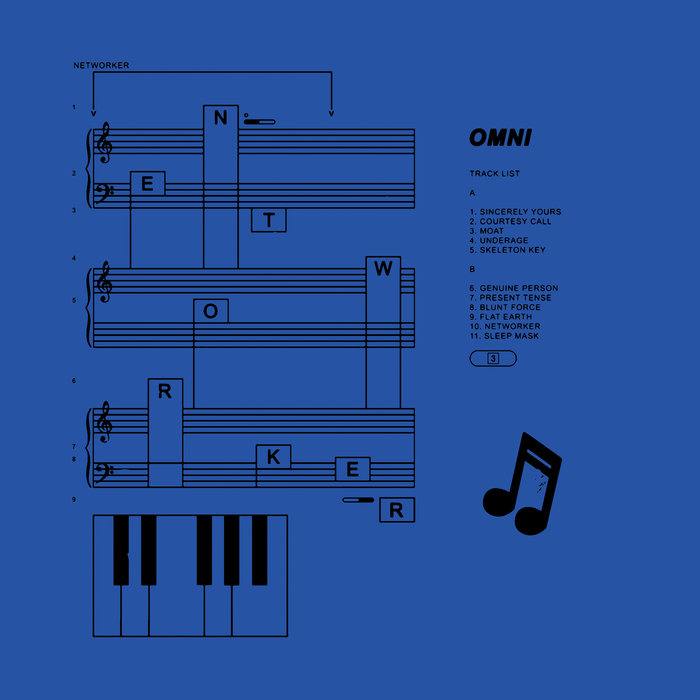
Atlanta’s own Omni manage to pull together what could certainly be considered a competent third LP, if not much else. Nothing serves to distinguish Networker’s singles “Sincerely Yours” and “Delicacy” from any other skippable track that flounders around on Spotify’s Post-Punk 2K playlist for a few weeks before being shelved by the great algorithm. Other tracks like “Blunt Force” manage to be vaguely interesting for a minute or two by virtue of experimenting with jazzier yet not no wave strains of post-punk; “Flat Earth” and “Moat” attempt to lean into Omni’s math rock roots, before immediately collapsing into 2016 Preoccupations-like half-heartedness. You do have to wonder about the state of Atlantan post-punk, if this is what the national playing field views as our most interesting asset. Surveying the fields of innovative young acts like Material Girls and Dicaprio, the question arises: “Really? This one?” —Five.
Sacred Bones synthpop darlings Black Marble return to grace post-punk with a surprisingly cohesive effort, after last year’s rather flat It’s Immaterial. Though Black Marble are one among many contemporary post-punk acts that could be (rightfully) criticized for mostly writing the same song over and over again, that one song is, admittedly, pretty good. “Grey Eyeliner” serves up playful frosted textures as Chris Stewart muses on the indeterminacy of longing and affection, and “One Eye Open”’s synths hit like determined razor blades as the track pitter patters a classic callback to a poppier, 2008 strain of coldwave. Almost nothing compares, however, to lead single and clear centerpiece “Private Show”. This song is nothing short of incredible. It’s genuinely one of the darkest and lushest pop songs of the entire year, and . It’s an incredible five-minute journey tinged with classic coldwave stylings and marked with a remarkably profound nostalgia. “Because I’d rather not drive,” Chris Stewart delivers in a glassy, harmonized monotone, “Cause it’s been a thousand years since I last tried.” As he ruminates— almost mourns— quietly, the gentle synth line rises behind him in a fashion similar to MGMT’s seminal synthpop gem “Time to Pretend”, evoking a deeply human longing that contrasts wryly Stewart’s resignation. “Come on, let’s go,” he finally concedes at the song’s conclusion, marking both the end of the track and one of the greatest post-punk singles of the decade. Seven and a half.
The concept of a Vicious Circle was first documented at the end of the 18th century, used to describe an argument which fed off of its own inherent premises, but this idea of a self-sufficient cycle is remembered more significantly for its political implications: it’s used to describe the inherent, fatalistic failure of man to learn from his past mistakes, dooming him to the same viciously turning set of motions across the stage of all known history. And the most bitter cycle of them all, of course, is the Vicious Circle of Post-Punk: excellent wave of post-punk emerges, after two years goes vaguely pop, British teenagers notice, British teenagers try to start bands, British teenagers ruin said wave of post-punk. The first twinge of fear arrived earlier this year when I asked FONTAINES D.C. what bands had inspired them to make music, and they replied, without a hint of irony, “The Strokes and The Libertines”. Without naming names, there seems to be a coming post-punk storm of young British men whose homepages are NME, who saw themselves in Peter Doherty at age thirteen, who’ve maybe attended a Fat White Family gig or two and referred to the experiences on Facebook as “f***ing mental”, so forgive me for thinking that the prospects for the genre look bleak. If there’s one thing What’s Inside is More Than Just Ham manages to accomplish, it’s the instillment of a deep, sorrowful bafflement inside of me. I listen to singles “English Weather” and “Petty Thieving” and picture the kind of person who possesses these tracks and hears them as interesting, worthwhile pieces of songwriting. I fight the urge to grab these anonymous figures by the shoulders and, like a madwoman, entreat: “Just listen to Shame. Please, just listen to Shame.” Even Bodega is less insufferably submerged in their own irony, and they don’t have to rely on quirky album titles or band names to get their point across. The rest of the record is more of the same: the title track gives off a “Tuxedomoon but all of their instruments are on fire and not in a cool artistic way either” vibe, “Dog Walking” is both intolerable and inoffensive, and “Axe Man” sounds like a Shame karaoke track, stripped of all personality and replaced with sterile canned guitar sounds from GuitarBand. And, of course, What’s Inside is More Than Just Ham ends with a neo-psychedelic, horrid little track titled “Wiggy Pop”. I survey a sea of LP’s titled 14 Year Old High School PC-Fascist Hype Lords Rip Off Devo for the Sake of Extorting $$$ from Helpless Impressionable Midwestern Internet Peoplepunks and singles titled “I Am Mark E. Smith” and I wonder: at what point, exactly, will third wave post-punk groups realize that name-checking your overt inspirations is only funny if there’s a punchline? —Four.
“No one in Girl Band actually looks like they want to be in Girl Band,” eloquently states Twitter user @dracuiamountain. It’s an apt assessment, even when addressing the music as opposed to the people: The Talkies turns the band’s signature misanthropy and discomfort up to eleven. Peripherally disaffectd indie darlings ever since 2014’s excellent Holding Hands With Jamie, Girl Band frequently load down The Talkies with song titles like “Aibophobia” and “Amygdela”. Lead single “Going Norway” is a brilliant piece of dry noise rock, following no set structure or form as frontman Dara Kiely drawls and calls out sardonic lyrics. Juttering, anxious riffs puncture the atmosphere of B-side tracks like “Caveat” and “Amygdela”, and further contribute to Girl Band’s infamous mood of intense, spider-webbing dread. Outliving peers like Total Control and outperforming newcomers like black midi, Girl Band skip over the sophomore slump and continue to prove that their name is worth being in the game. —Eight.
Blindingly trendy and piping hot off the Speedy Wunderground presses, Squid’s Town Centre manages, surprisingly, to live up to its expectations and deliver an excellent twenty three minute cut of art punk. Opening with the no wave flavored instrumental track “Savage”, Town Centre swiftly verge into delicately composed dance-punk ditties like “Match Bet” and “The Cleaner”. Though I hesitate to belay any band with the intolerable weight of hype, Town Centre provides a tantalizing glimpse of a likely excellent full-length debut in Squid’s near future. —Seven and a half.
There’s not much to say about late post-punk revival or landfill indie that hasn’t been thinkpieced to death and back already. I’m an admitted apologist for 2004’s The Futureheads, though not so much that I can’t recognize what a piece of half-hearted new wave garbage Powers is. It’s genuinely saddening to watch the supposed “winners” of British landfill indie— Kaiser Chiefs, Kasabian, The Wombats— resort to limply slapping a new wave sheen on the same regurgitated post-punk revival ideas, heavy on the revival, light on the post-punk. (Hell, even Two Door Cinema Club did it earlier this year, and it was somehow a damn lot better than everything else I’ve named so far.) There’s really not much to say about the music itself. Lead single “Jekyll” is vaguely redeemable and opens with a bit of an attitude, but descends into something so pathetically glam that it reminds me of the infamous Atlanta darkwave locals The Cruxshadows. Nothing else gets much better, as “Good Night Out” is legitimately painful to listen to from the convoluted, abrasive onset, and “Idle Hands” is as weirdly written and unenjoyable as the guitar intro to a track off of Interpol’s El Pintor. And the closer, “Mortals”, sort of hops awkwardly along like something that would play in a Hot Topic at 8:56 PM as you wander through racks of Gorillaz and Panic! at the Disco scoop neck tees, a light film of warm cinnamon donut sugar obscuring your vision, and the lone, heavily pierced employee boring a hole into your back. —Three and a half.
Fresh on the heels of fellow Irish hype bands FONTAINES D.C. and Just Mustard, The Murder Capital, unfortunately disappoint with the hotly anticipated When I Have Fears. While The Murder Capital deliver perfectly adequate and even enjoyable guitarwork (especially on “Don’t Cling to Life” and “For Everything”), McGovern’s vocals are a decidedly weak point, straddling the line between being excellently forceful or excellently boyish, and end up failing at both. Other songs sound half-baked, puttering out or limping along instead of trying to make your blood run hot. At the very least, The Murder Capital are trying something new rather than re-treading the same “flirtation with new wave and/or post-punk revival” ground as their contemporaries, and explosions of grimy sound at the end of “For Everything” and “Love, Love, Love” hint at a great record buried beneath muddled production. we’re looking forward to a record that sounds like it’s had some more incubation and rehabilitation in the recording studio. —Five and a half.
This week, London duo Crushed Beaks surprise with an incredibly solid sophomore offering, sequel to 2015’s Scatter. With canon-heavy shoegaze moments (the reverb is turned to the max on “Sky Burial” and “Honesty Box”), The Other Room is a lovely blend of traditional indie rock, shoegaze, and post-punk. Standout tracks include “Sky Burial” and “Out on a Limb”, the latter of which opens with a pretty distinctively Loveless moment. In short, in one record, Crushed Beaks accomplish what DIIV has been trying to achieve for the better part of a decade. —Eight and a half.